

This report reflects the market at the time it was published. Rates and local conditions change; contact Michael for today’s information.
Mortgage rates have been making headlines again, and for good reason. With rates hovering around 7%, many buyers are wondering whether it makes sense to purchase a home now or wait for borrowing costs to improve.
But there is another side to the story that deserves attention.
Across Greater Seattle, particularly in King and Snohomish counties, the housing market has changed considerably over the past year. Buyers have more homes to choose from, properties are facing more competition, and sellers are becoming increasingly aware of the importance of realistic pricing.
The question isn't simply whether mortgage rates are high. It's whether today's market offers opportunities that may not be available when rates eventually come down.
1. Buyers have significantly more homes to choose from
One of the biggest changes in our local housing market is the increase in available homes.
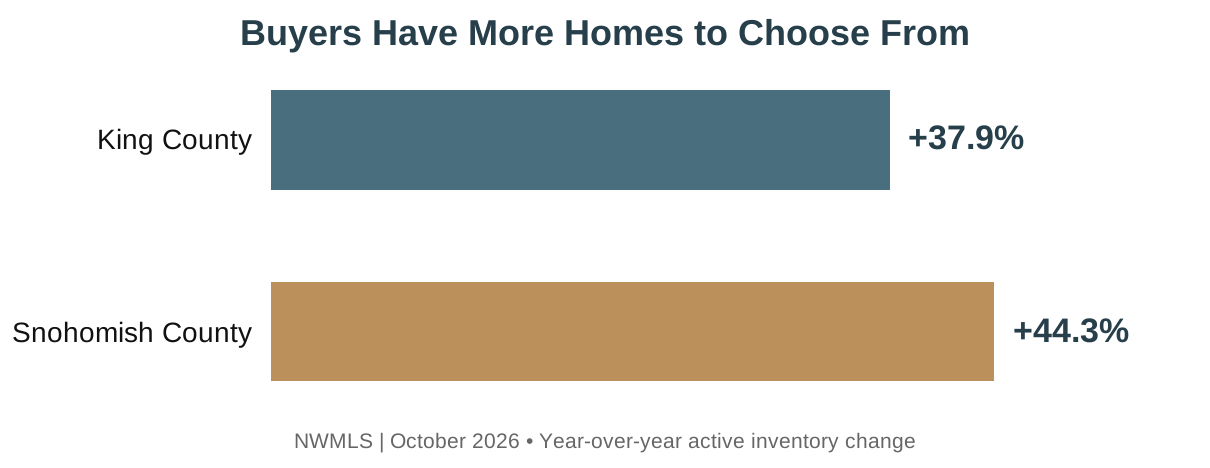
According to the Northwest Multiple Listing Service, October 2026 single-family home inventory increased 37.9% in King County and 44.3% in Snohomish County compared with October 2025.
That is a substantial change in just one year.
For buyers searching in Seattle, Shoreline, Edmonds, Lynnwood, Bothell, or surrounding communities, additional inventory can mean more choices in location, condition, layout, and price.
It also means buyers may have more time to evaluate their options rather than feeling pressured to make an immediate decision.
Of course, desirable homes that are priced correctly can still attract strong interest. But the overall market is offering buyers more breathing room than we've seen in recent years.
2. Fewer buyers are competing for those homes
While inventory has increased, the number of homes going under contract has declined.
In October, pending single-family home sales were down 15.6% in King County and 18.6% in Snohomish County compared with a year earlier.
This combination of more available homes and fewer pending sales is changing the negotiating environment.
Sellers have more competition, and buyers have more opportunities to compare properties before making an offer.
For someone who remembers the market of 2021 and early 2022, when multiple offers and waived contingencies were common, today's conditions can feel quite different.
Buyers may now have greater opportunities to negotiate price, request repairs, or discuss closing costs, depending on the property and the seller's circumstances.
3. Home prices are adjusting across Greater Seattle
The latest numbers also show that home prices have softened.
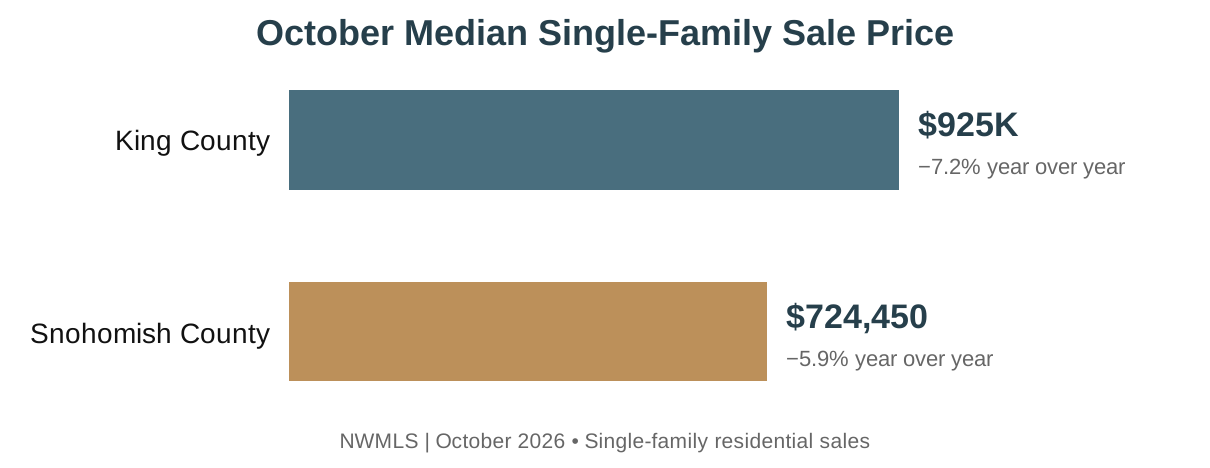
In October 2026, the median single-family home sale price in King County was $925,000, down 7.2% from the previous year.
In Snohomish County, the median was $724,450, a decline of 5.9%.
These figures don't mean every home's value has fallen by the same percentage. Median prices reflect the homes that sold during a particular month, and the mix of those properties can change.
Still, the broader trend is worth paying attention to.
In communities such as Shoreline, Edmonds, Lynnwood, and Bothell, buyers are comparing available homes carefully. Properties that are priced above what the market supports may experience longer marketing times or require adjustments.
For sellers, this reinforces the importance of understanding the competition before choosing an asking price.
For buyers, it creates opportunities to identify homes where the asking price may be more flexible.
4. Higher mortgage rates don't tell the whole story
Mortgage rates remain one of the biggest challenges facing today's buyers.
Freddie Mac reported that the average 30-year fixed mortgage rate was 7.11% as of November 12, 2026, compared with 6.24% one year earlier.
That difference affects monthly payments and purchasing power.
However, mortgage rates are only one part of the cost of purchasing a home.
Consider a home listed at $800,000.
If a buyer negotiates a $25,000 reduction, the purchase price becomes $775,000. With 20% down and a hypothetical 7% mortgage rate, that lower purchase price reduces the monthly principal and interest payment by approximately $133.
A buyer might also negotiate seller assistance with closing costs or a mortgage rate buydown, subject to loan requirements and the seller's willingness.
These opportunities aren't guaranteed, and a price reduction doesn't automatically offset higher borrowing costs.
But they illustrate why it's important to look beyond the mortgage rate when evaluating a purchase.
5. What happens if mortgage rates come down?
Many buyers are waiting for lower interest rates before making a move.
That's understandable. A lower rate can make a meaningful difference in affordability.
But there is a trade-off worth considering.
If mortgage rates decline enough to bring more buyers back into the market, competition for desirable homes could increase. That could mean fewer opportunities to negotiate and more pressure on prices.
There is no guarantee that will happen, just as there is no guarantee that rates will decline significantly in the near future.
The important point is that waiting for a lower rate doesn't necessarily mean the overall cost of purchasing a home will be lower.
A buyer who finds the right property today, at a price and payment they can comfortably afford, may have an opportunity worth considering.
And a buyer who needs to wait for financial reasons should absolutely do so.
The decision should be based on personal circumstances, not an attempt to perfectly time the market.
6. What this means for sellers in our local market
For homeowners considering selling, today's market requires a thoughtful approach.
Buyers have more choices, and many are taking additional time to compare properties before scheduling showings or making offers.
That makes pricing, condition, presentation, and marketing especially important.
A home that is priced appropriately and shows well can still attract serious buyers. But a property that enters the market above what comparable sales support may struggle to generate activity.
In my experience, the first few weeks of a listing provide valuable information about how buyers are responding.
Showings, feedback, competing listings, and recent sales all help determine whether a home is positioned correctly.
The goal isn't simply to put a home on the market. It's to position it to compete effectively under current conditions.
What this means in our local market
Real estate conditions can vary considerably from one neighborhood to another.
A well-maintained home in Edmonds may perform differently from a similar property in Shoreline, Lynnwood, Kenmore, or Bothell. Price range, location, condition, and the number of competing homes all influence buyer activity.
That's why countywide statistics are a useful starting point, but they don't replace a careful review of what's happening in your particular neighborhood.
For buyers, this may be a good time to explore opportunities that weren't available when competition was stronger.
For sellers, understanding current buyer expectations and pricing realistically can make a meaningful difference.
The bottom line
You rarely get both low mortgage rates and strong negotiating power at the same time.
Today's Greater Seattle housing market presents challenges, but it also offers opportunities.
Buyers have more choices and, in some situations, greater flexibility to negotiate. Sellers need to be more strategic about pricing and presentation.
Neither side should make decisions based solely on headlines about mortgage rates or home prices.
After more than 26 years helping people buy and sell homes throughout North King and South Snohomish counties, I've seen how quickly market conditions can change.
What matters most is understanding the market you're moving in and making decisions that support your goals.
If you're thinking about buying or selling, I'd be happy to help you look at the numbers in your neighborhood and talk through your options.
- Northwest Multiple Listing Service — October 2026 County Recaps. Single-family residential statistics for King and Snohomish Counties; local results vary by neighborhood and property type.
- Northwest Multiple Listing Service — October 2026 Market Snapshot
- Freddie Mac — Primary Mortgage Market Survey, November 12, 2026
Bring the market into focus
What does this mean for your move?
Michael will help you compare the broader trends with the latest activity in your neighborhood and price range.